Argus
Natural-language automation compiled by an LLM, run by a deterministic engine.
Version: 0.3.4
Added: 21-08-2026
Updated: 02-09-2026
Added: 21-08-2026
Updated: 02-09-2026
Argus is a Tasker-class automation app where a large language model is the compiler, not the executor.
You describe a rule in plain language — "every day at 9 send me the BTC price", "when I leave home turn off Wi-Fi", "if an OTP arrives, copy it to the clipboard". The model compiles your request into a structured, typed rule (trigger, conditions, actions). You review it rendered from the types — never from the model's paraphrase — and approve a byte-stable SHA-256 fingerprint of the executable data. From then on a deterministic engine runs the rule: OS alarms, system receivers, geofences, the notification listener. The model is never in the execution loop, except for actions you explicitly mark as generative.
Why this matters:
* Predictable — the rule that fires at 3 a.m. is exactly the one you approved, byte for byte.
* Auditable — every run is logged locally, without personal content.
* Private by design — no Argus-operated backend or account, no telemetry and no analytics. Rules, logs and encrypted API keys stay on your phone; only the provider or self-hosted bridge you explicitly configure receives compile/generative requests.
The language-model transport is pluggable: run a self-hosted bridge, or connect directly to a provider you choose. A base tier works with no elevated privileges; for system-level actions Argus can use Shizuku.
Note: connecting a proprietary provider (OpenAI, Anthropic, Google) is optional — Argus can instead use a self-hosted bridge together with its on-device deterministic actions.
Argus is free software (GPL-3.0). The interface, rule rendering and the agent all follow your system language (English or Italian).
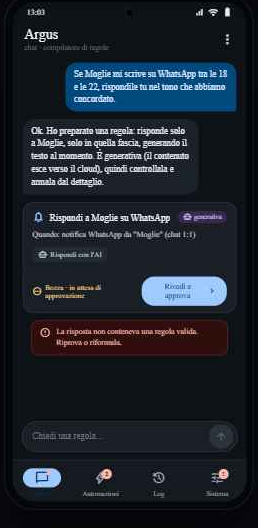
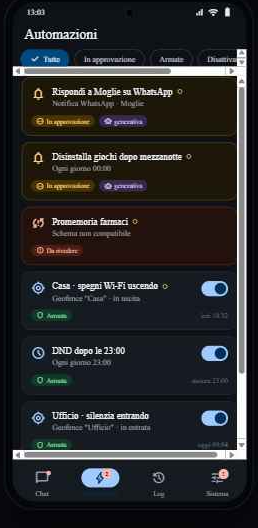
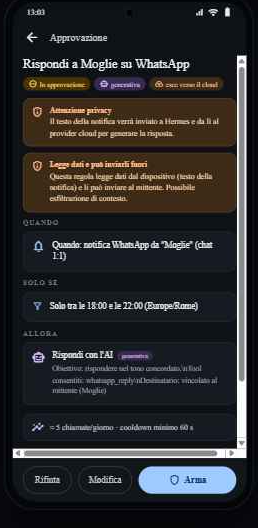
You describe a rule in plain language — "every day at 9 send me the BTC price", "when I leave home turn off Wi-Fi", "if an OTP arrives, copy it to the clipboard". The model compiles your request into a structured, typed rule (trigger, conditions, actions). You review it rendered from the types — never from the model's paraphrase — and approve a byte-stable SHA-256 fingerprint of the executable data. From then on a deterministic engine runs the rule: OS alarms, system receivers, geofences, the notification listener. The model is never in the execution loop, except for actions you explicitly mark as generative.
Why this matters:
* Predictable — the rule that fires at 3 a.m. is exactly the one you approved, byte for byte.
* Auditable — every run is logged locally, without personal content.
* Private by design — no Argus-operated backend or account, no telemetry and no analytics. Rules, logs and encrypted API keys stay on your phone; only the provider or self-hosted bridge you explicitly configure receives compile/generative requests.
The language-model transport is pluggable: run a self-hosted bridge, or connect directly to a provider you choose. A base tier works with no elevated privileges; for system-level actions Argus can use Shizuku.
Note: connecting a proprietary provider (OpenAI, Anthropic, Google) is optional — Argus can instead use a self-hosted bridge together with its on-device deterministic actions.
Argus is free software (GPL-3.0). The interface, rule rendering and the agent all follow your system language (English or Italian).