Ausha
Listen to your computer's audio on your phone over Wi-Fi
Version: 0.1.2
Added: 23-11-2026
Updated: 23-11-2026
Added: 23-11-2026
Updated: 23-11-2026
Ausha turns your phone into a wireless speaker for your computer, and into the computer's microphone on the way back.
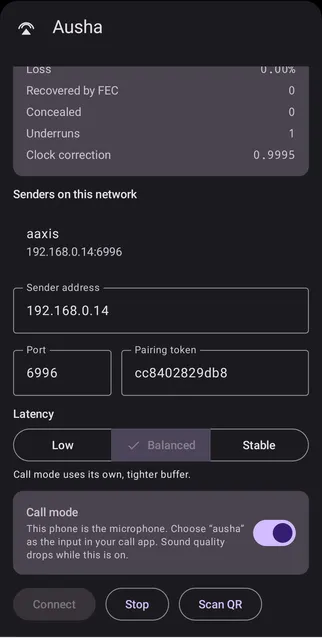
Whatever the computer is playing — music, a video, a call — comes out of the phone over your Wi-Fi, with a delay small enough to watch video against. Turn on call mode and the phone's microphone goes back the other way, so the phone works as a wireless headset for a call you take on the computer.
You also need the sender on your computer
This app is the receiver half of Ausha. On its own it does nothing: it needs the free Ausha sender running on a computer on the same Wi-Fi network. The sender is a Linux command-line program, built from the same source repository linked below.
Pairing
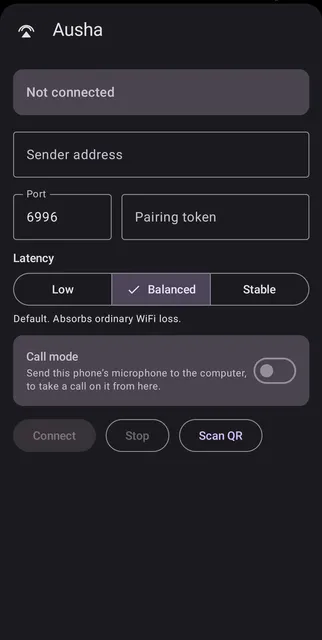
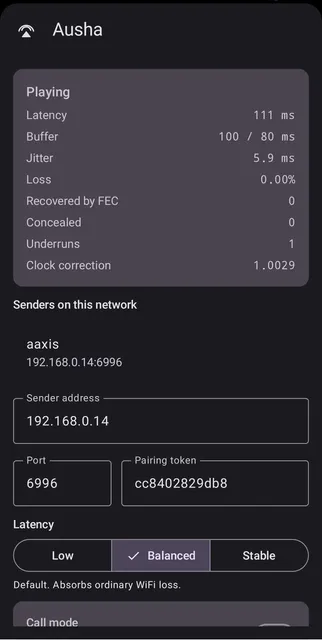
The sender prints a QR code. Scan it and audio starts. If your router passes mDNS the app also lists senders it finds on the network, so you can tap one instead.
Built for a real Wi-Fi network
Audio is Opus in RTP over UDP, in 20 ms frames. A jitter buffer, forward error correction and packet loss concealment handle the losses a normal access point produces, and clock drift between the two devices is corrected continuously so playback never slowly runs dry. You can trade delay against resilience: low, balanced or stable.
Privacy
Everything stays on your local network. There are no accounts, no servers, no analytics and no advertising identifiers. The app talks only to the computer you paired it with, authenticated by a pairing code the sender generates; audio can optionally be encrypted end to end. The INTERNET permission is used for local sockets only. The camera is used solely to read the pairing QR code, and the microphone only while call mode is switched on.
Good to know
• The sender currently runs on Linux; the Windows sender is written but untested, and there is no macOS sender yet.
• Use headphones on the phone in call mode. Echo cancellation on speakerphone has not been confirmed on real hardware, so without headphones the person you are talking to may hear themselves.
• Guest and hotel Wi-Fi networks often block device-to-device traffic, which stops Ausha from connecting.
Whatever the computer is playing — music, a video, a call — comes out of the phone over your Wi-Fi, with a delay small enough to watch video against. Turn on call mode and the phone's microphone goes back the other way, so the phone works as a wireless headset for a call you take on the computer.
You also need the sender on your computer
This app is the receiver half of Ausha. On its own it does nothing: it needs the free Ausha sender running on a computer on the same Wi-Fi network. The sender is a Linux command-line program, built from the same source repository linked below.
Pairing
The sender prints a QR code. Scan it and audio starts. If your router passes mDNS the app also lists senders it finds on the network, so you can tap one instead.
Built for a real Wi-Fi network
Audio is Opus in RTP over UDP, in 20 ms frames. A jitter buffer, forward error correction and packet loss concealment handle the losses a normal access point produces, and clock drift between the two devices is corrected continuously so playback never slowly runs dry. You can trade delay against resilience: low, balanced or stable.
Privacy
Everything stays on your local network. There are no accounts, no servers, no analytics and no advertising identifiers. The app talks only to the computer you paired it with, authenticated by a pairing code the sender generates; audio can optionally be encrypted end to end. The INTERNET permission is used for local sockets only. The camera is used solely to read the pairing QR code, and the microphone only while call mode is switched on.
Good to know
• The sender currently runs on Linux; the Windows sender is written but untested, and there is no macOS sender yet.
• Use headphones on the phone in call mode. Echo cancellation on speakerphone has not been confirmed on real hardware, so without headphones the person you are talking to may hear themselves.
• Guest and hotel Wi-Fi networks often block device-to-device traffic, which stops Ausha from connecting.