Ironvellum
Strength training with a ledger that remembers everything.
Version: 1.6
Added: 12-10-2026
Updated: 12-10-2026
Added: 12-10-2026
Updated: 12-10-2026
An Android training tracker that scores what you actually lift. Seal a trial,
get a number that means something.
Most trackers add up kilograms, which rewards being heavy.
Ironvellum scores a set by what it costs you:
- Body-scaled: a rep is worth reps × (bodyweight + added) / bodyweight^0.67,
the allometric exponent, so a lighter body is not outranked for being light.
- Priced per implement: a marked kilogram is not the same load on every
machine. The plate you see is converted to the load you actually carry.
- Difficulty-weighted: a handstand push-up and a push-up are not the same rep.
Tiers come from the Paths, the app's technique tree.
- Per-sex standards: strength score is normalised by muscle group using
published gaps, and every strength deed states the bar for the person
reading it.
Everything works offline. An account is optional and only ever backs up
training.
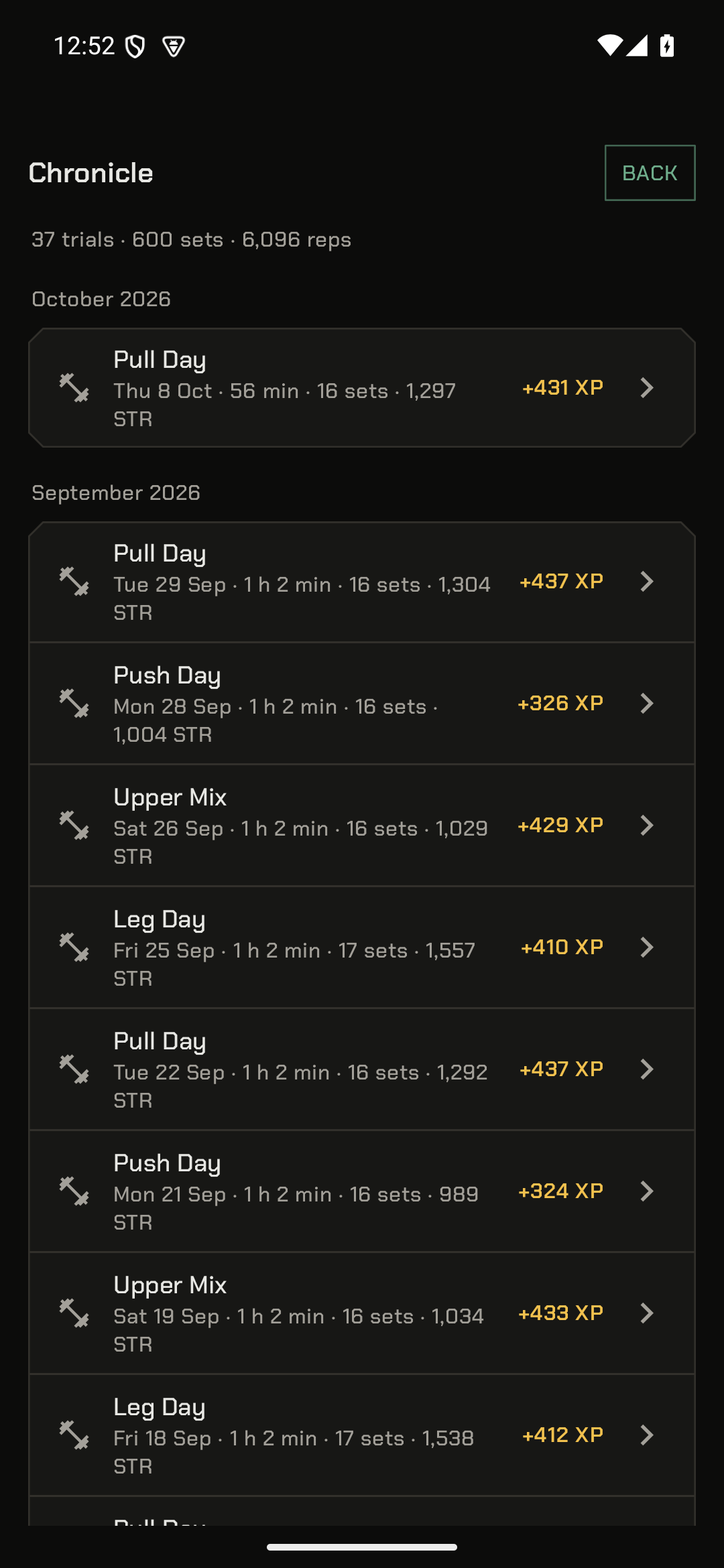
The app keeps its own words. A saved workout is a rite, your weekly plan
is a cycle, and a workout you perform is a trial, sealed when you finish and
written into your chronicle.
Features:
- The Binding, a guided first run: pick your split, weekly volume, armoury
(the equipment you own) and goal, and the app proposes an editable cycle
built from the real catalogue. No cycle is imposed on you.
- The Forge, an evidence-based builder: full body, upper/lower and
push/pull/legs for strength or muscle, fitted to your volume and armoury,
from a full gym to a pull-up bar. Forge a cycle or a rite, or temper one you
have. Every pick cites 2020-2026 research.
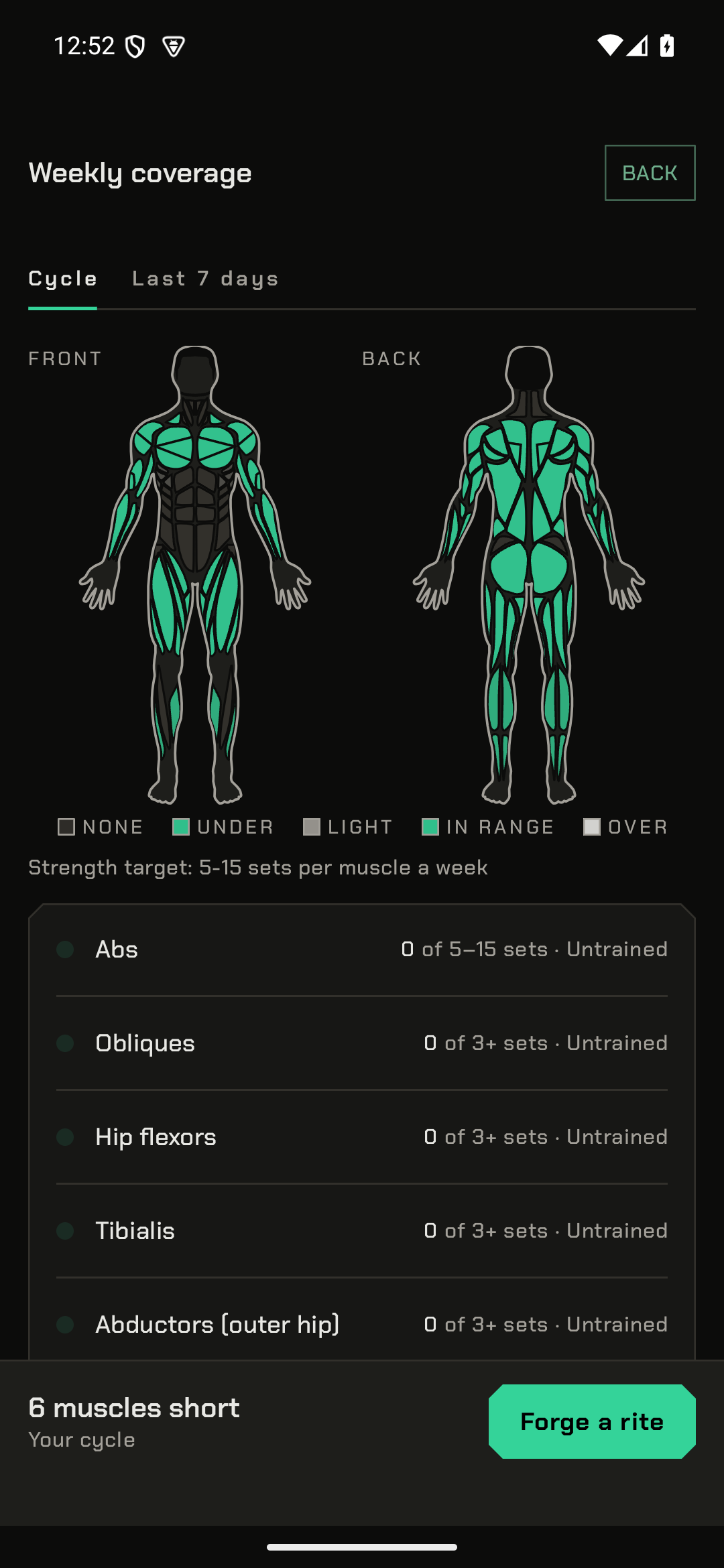
- Weekly coverage: an anatomical body map, male or female to match your
profile, of the sets each muscle gets, in your cycle or from the last seven
days, as one list with the short muscles first and a Forge a rite bar. Tap a
muscle on any figure to light it. Every exercise and technique has a
swipeable info sheet showing the muscles it works.
- Live trials: type a set's exact load and it carries to your later sets. Rest
by each movement's own window with a ready buzz, trim it by 15 s, mark
warm-up sets, add a warm-up step, keep a note per exercise and Undo a
removed set. Continue a trial you left. After a trial, pick which changes
and which swapped exercises go back into your cycle.
- 256 exercises: barbell, dumbbell, cable, plate-loaded, selectorised, smith,
assisted, bodyweight, plus cardio, sport, climbing, water and mobility.
- 119 techniques on fourteen paths, shown as game-style nodes, each gated on
the one before it and carrying a written claim standard.
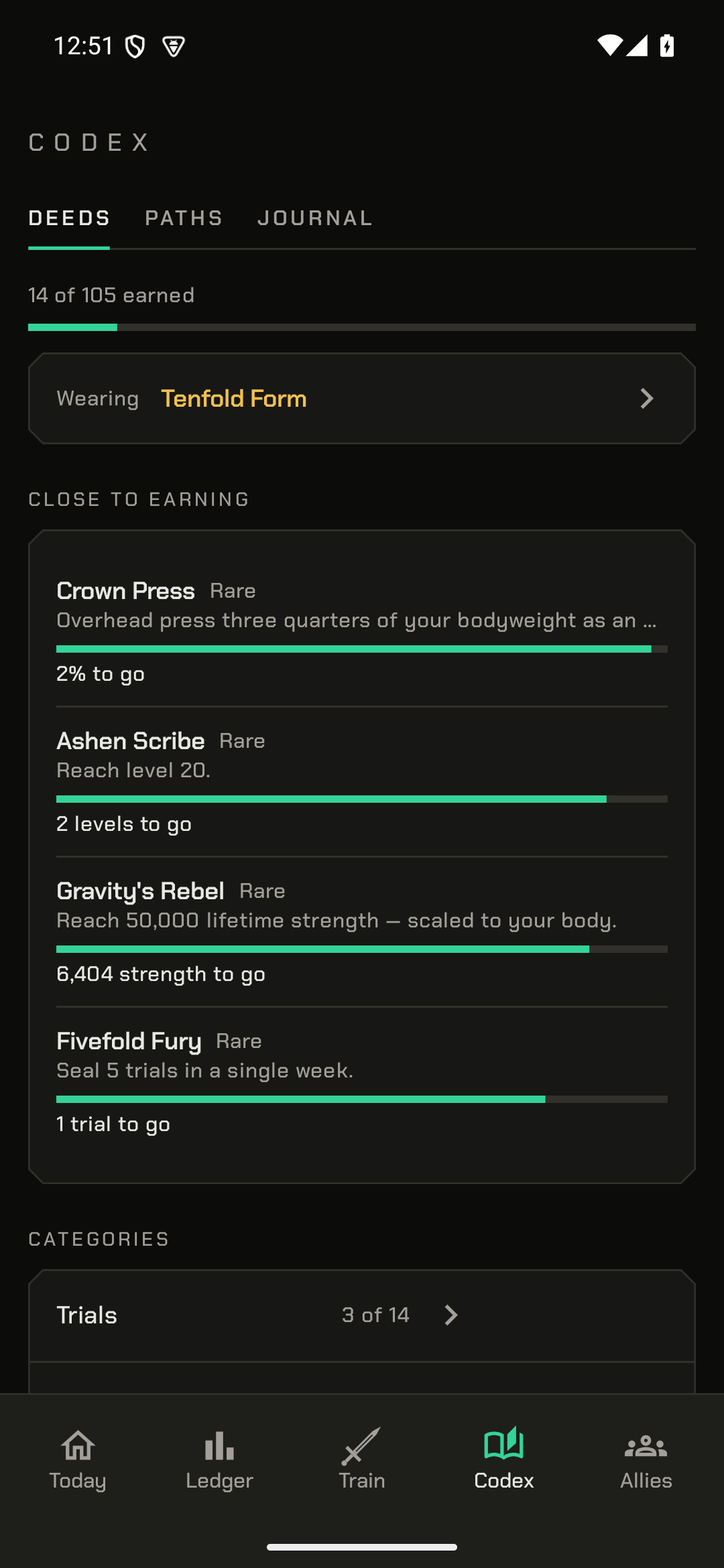
- 105 deeds: level, volume, oath (days kept in a row), strength and activity
milestones, with progress you can watch rather than a surprise.
- Progressive overload: strength and hypertrophy schools with their own rep
bands, per-exercise load steps and a stall rule that deloads instead of
repeating a failed trial. Control and mobility moves progress on range,
tempo or hold time, and bodyweight reps cap at 15 before load.
- The Ledger: scrubbable charts for weight, body fat, BMI and FFMI, a training
calendar and lift records; optional Health Connect read (weight, body fat,
resting heart rate, steps, distance, energy and sleep), including past
history and a background refresh while the app is closed.
- A flat Clean look, bottom sheets and accent pairs you can change.
- Shareable trials: a plain text card shaped after Wordle, no link and no
image, that states only what you did.
- Optional cloud: sign in to back up training, follow your allies' tidings,
form a circle with a weekly goal and stand in the Reckoning, a leaderboard
for each lift. Body measurements and health data never leave the device. Delete your cloud account from the app
at any time.
Ironvellum is free software (GPL-3.0-or-later) with no ads, trackers or
paid tier. Source: https://github.com/AlexMollard/Ironvellum
get a number that means something.
Most trackers add up kilograms, which rewards being heavy.
Ironvellum scores a set by what it costs you:
- Body-scaled: a rep is worth reps × (bodyweight + added) / bodyweight^0.67,
the allometric exponent, so a lighter body is not outranked for being light.
- Priced per implement: a marked kilogram is not the same load on every
machine. The plate you see is converted to the load you actually carry.
- Difficulty-weighted: a handstand push-up and a push-up are not the same rep.
Tiers come from the Paths, the app's technique tree.
- Per-sex standards: strength score is normalised by muscle group using
published gaps, and every strength deed states the bar for the person
reading it.
Everything works offline. An account is optional and only ever backs up
training.
The app keeps its own words. A saved workout is a rite, your weekly plan
is a cycle, and a workout you perform is a trial, sealed when you finish and
written into your chronicle.
Features:
- The Binding, a guided first run: pick your split, weekly volume, armoury
(the equipment you own) and goal, and the app proposes an editable cycle
built from the real catalogue. No cycle is imposed on you.
- The Forge, an evidence-based builder: full body, upper/lower and
push/pull/legs for strength or muscle, fitted to your volume and armoury,
from a full gym to a pull-up bar. Forge a cycle or a rite, or temper one you
have. Every pick cites 2020-2026 research.
- Weekly coverage: an anatomical body map, male or female to match your
profile, of the sets each muscle gets, in your cycle or from the last seven
days, as one list with the short muscles first and a Forge a rite bar. Tap a
muscle on any figure to light it. Every exercise and technique has a
swipeable info sheet showing the muscles it works.
- Live trials: type a set's exact load and it carries to your later sets. Rest
by each movement's own window with a ready buzz, trim it by 15 s, mark
warm-up sets, add a warm-up step, keep a note per exercise and Undo a
removed set. Continue a trial you left. After a trial, pick which changes
and which swapped exercises go back into your cycle.
- 256 exercises: barbell, dumbbell, cable, plate-loaded, selectorised, smith,
assisted, bodyweight, plus cardio, sport, climbing, water and mobility.
- 119 techniques on fourteen paths, shown as game-style nodes, each gated on
the one before it and carrying a written claim standard.
- 105 deeds: level, volume, oath (days kept in a row), strength and activity
milestones, with progress you can watch rather than a surprise.
- Progressive overload: strength and hypertrophy schools with their own rep
bands, per-exercise load steps and a stall rule that deloads instead of
repeating a failed trial. Control and mobility moves progress on range,
tempo or hold time, and bodyweight reps cap at 15 before load.
- The Ledger: scrubbable charts for weight, body fat, BMI and FFMI, a training
calendar and lift records; optional Health Connect read (weight, body fat,
resting heart rate, steps, distance, energy and sleep), including past
history and a background refresh while the app is closed.
- A flat Clean look, bottom sheets and accent pairs you can change.
- Shareable trials: a plain text card shaped after Wordle, no link and no
image, that states only what you did.
- Optional cloud: sign in to back up training, follow your allies' tidings,
form a circle with a weekly goal and stand in the Reckoning, a leaderboard
for each lift. Body measurements and health data never leave the device. Delete your cloud account from the app
at any time.
Ironvellum is free software (GPL-3.0-or-later) with no ads, trackers or
paid tier. Source: https://github.com/AlexMollard/Ironvellum