KeepADB
Keep Wireless Debugging active and toggle it from a tile or widget
Version: 1.8.38
Added: 27-09-2026
Updated: 27-09-2026
Added: 27-09-2026
Updated: 27-09-2026
KeepADB helps keep Android Wireless Debugging available across device restarts, Wi-Fi reconnects, access-point changes, and idle periods.
Toggle Wireless Debugging from the main screen, a Quick Settings tile, or a home-screen widget. An optional foreground service monitors the connection and attempts recovery when Android disables it. Android may ask you to approve Wireless Debugging on a Wi-Fi network. If Android does not confirm an automatic enable, KeepADB backs off instead of retrying rapidly.
Features:
* Quick Settings tile, home-screen widget, and main app controls
* Optional Keep-Alive service across restarts and network changes
* Endpoint discovery through Android NSD/mDNS (_adb-tls-connect._tcp); timing depends on network conditions
* Optional HTTP(S) webhook, disabled by default, for verified WLAN-ADB endpoints
* Configurable status notification, endpoint display, and privacy mode to hide addresses in the app
* Network (Beta) Wi-Fi and access-point tools, plus an optional trusted-network restriction
* 19 interface languages and right-to-left layout support
* No advertising, analytics, tracking, or third-party runtime libraries
On fresh installs, trusted-network filtering is off, so Keep-Alive may use any connected Wi-Fi network. Enabling the restriction requires Android location access to identify networks. Android may mask that identity in the background, which can pause automatic recovery. KeepADB uses location access only to identify the Wi-Fi network; it does not read or store your location.
When USB debugging is connected, KeepADB can show a USB notification and associate it with an editable host profile stored on the device. It can optionally offer or perform a USB-to-WLAN handover. USB profile data is not sent through the current webhook contract.
KeepADB does not require root. Android protects Wireless Debugging with the WRITE_SECURE_SETTINGS permission, so initial setup requires granting it once from a trusted computer with ADB:
adb shell pm grant de.hohnepeople.keepadb android.permission.WRITE_SECURE_SETTINGS
Wireless Debugging exposes an authenticated development service on the connected network. Use Keep-Alive on networks you trust, turn Wireless Debugging off on public hotspots, and reject unexpected Android approval or pairing prompts.
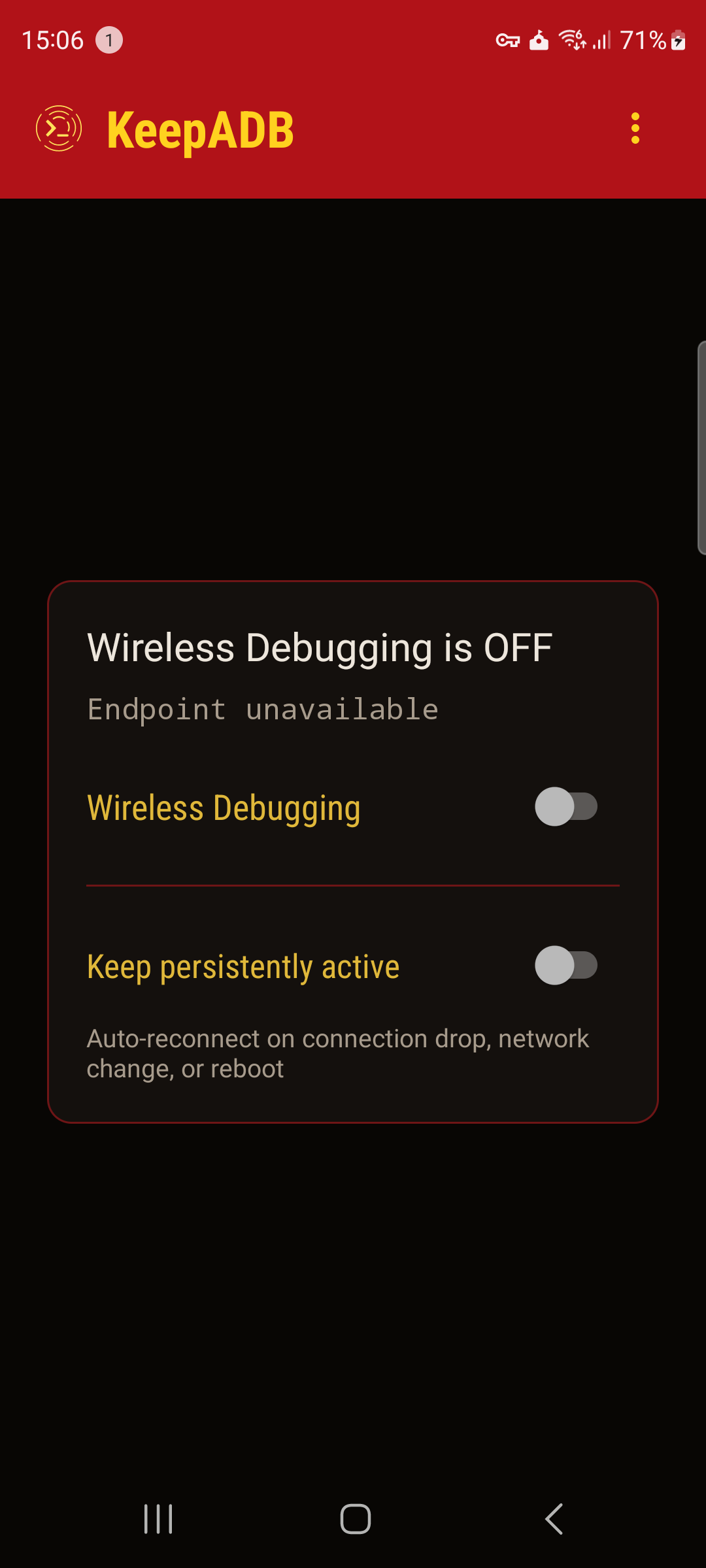
Toggle Wireless Debugging from the main screen, a Quick Settings tile, or a home-screen widget. An optional foreground service monitors the connection and attempts recovery when Android disables it. Android may ask you to approve Wireless Debugging on a Wi-Fi network. If Android does not confirm an automatic enable, KeepADB backs off instead of retrying rapidly.
Features:
* Quick Settings tile, home-screen widget, and main app controls
* Optional Keep-Alive service across restarts and network changes
* Endpoint discovery through Android NSD/mDNS (_adb-tls-connect._tcp); timing depends on network conditions
* Optional HTTP(S) webhook, disabled by default, for verified WLAN-ADB endpoints
* Configurable status notification, endpoint display, and privacy mode to hide addresses in the app
* Network (Beta) Wi-Fi and access-point tools, plus an optional trusted-network restriction
* 19 interface languages and right-to-left layout support
* No advertising, analytics, tracking, or third-party runtime libraries
On fresh installs, trusted-network filtering is off, so Keep-Alive may use any connected Wi-Fi network. Enabling the restriction requires Android location access to identify networks. Android may mask that identity in the background, which can pause automatic recovery. KeepADB uses location access only to identify the Wi-Fi network; it does not read or store your location.
When USB debugging is connected, KeepADB can show a USB notification and associate it with an editable host profile stored on the device. It can optionally offer or perform a USB-to-WLAN handover. USB profile data is not sent through the current webhook contract.
KeepADB does not require root. Android protects Wireless Debugging with the WRITE_SECURE_SETTINGS permission, so initial setup requires granting it once from a trusted computer with ADB:
adb shell pm grant de.hohnepeople.keepadb android.permission.WRITE_SECURE_SETTINGS
Wireless Debugging exposes an authenticated development service on the connected network. Use Keep-Alive on networks you trust, turn Wireless Debugging off on public hotspots, and reject unexpected Android approval or pairing prompts.