Nonius
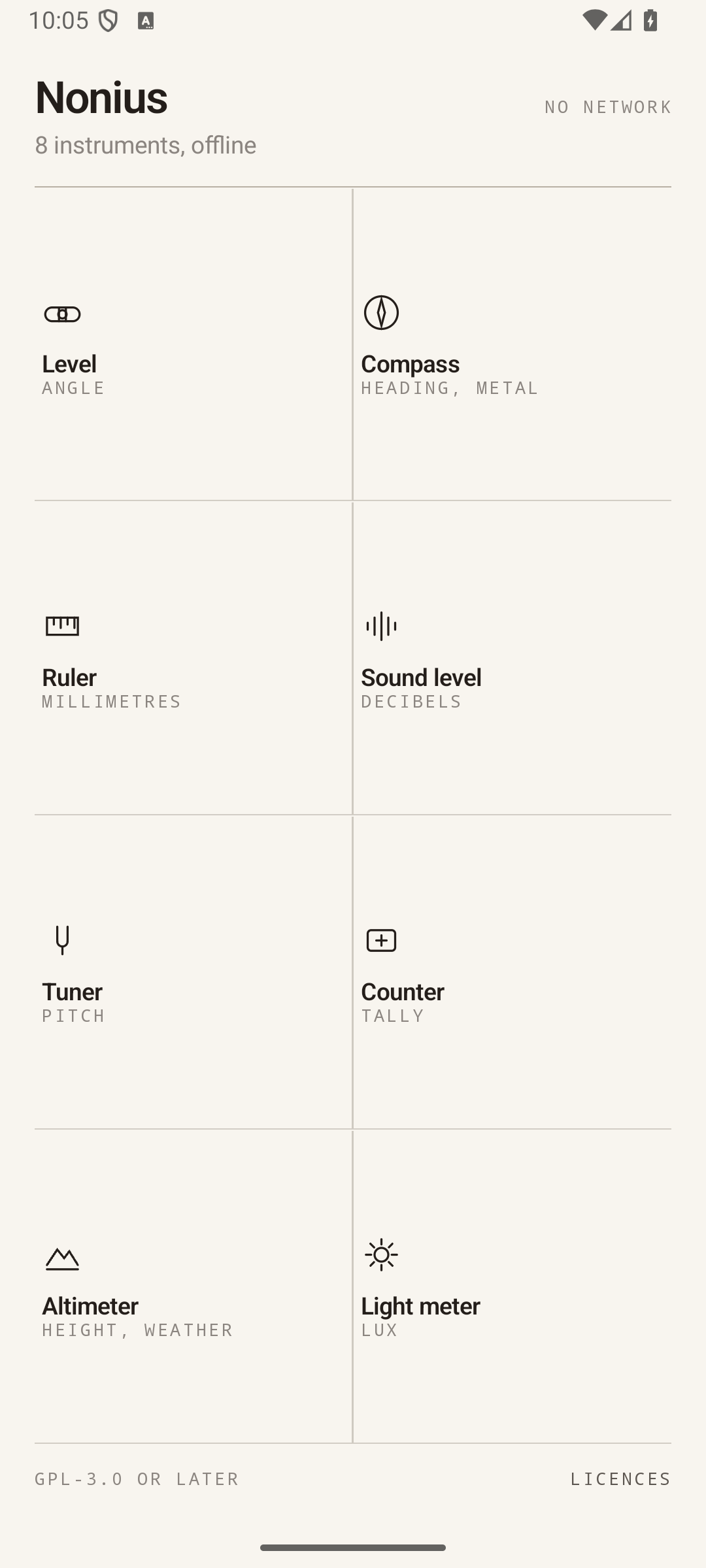
Ten measuring instruments. No ads, no trackers, no network.
Version: 1.3
Added: 15-09-2026
Updated: 29-09-2026
Added: 15-09-2026
Updated: 29-09-2026
Your phone has a gravity sensor, a magnetometer, a barometer, a light sensor and a microphone. Android gives you none of them. The apps that fill the gap are mostly a banner ad with a bubble drawn on top.
Nonius is the other kind. Every face is drawn as an instrument rather than assembled from stock components, and every reading that depends on hardware has a calibration you can set, because no sensor is perfect and no screen reports its own size honestly.
The instruments
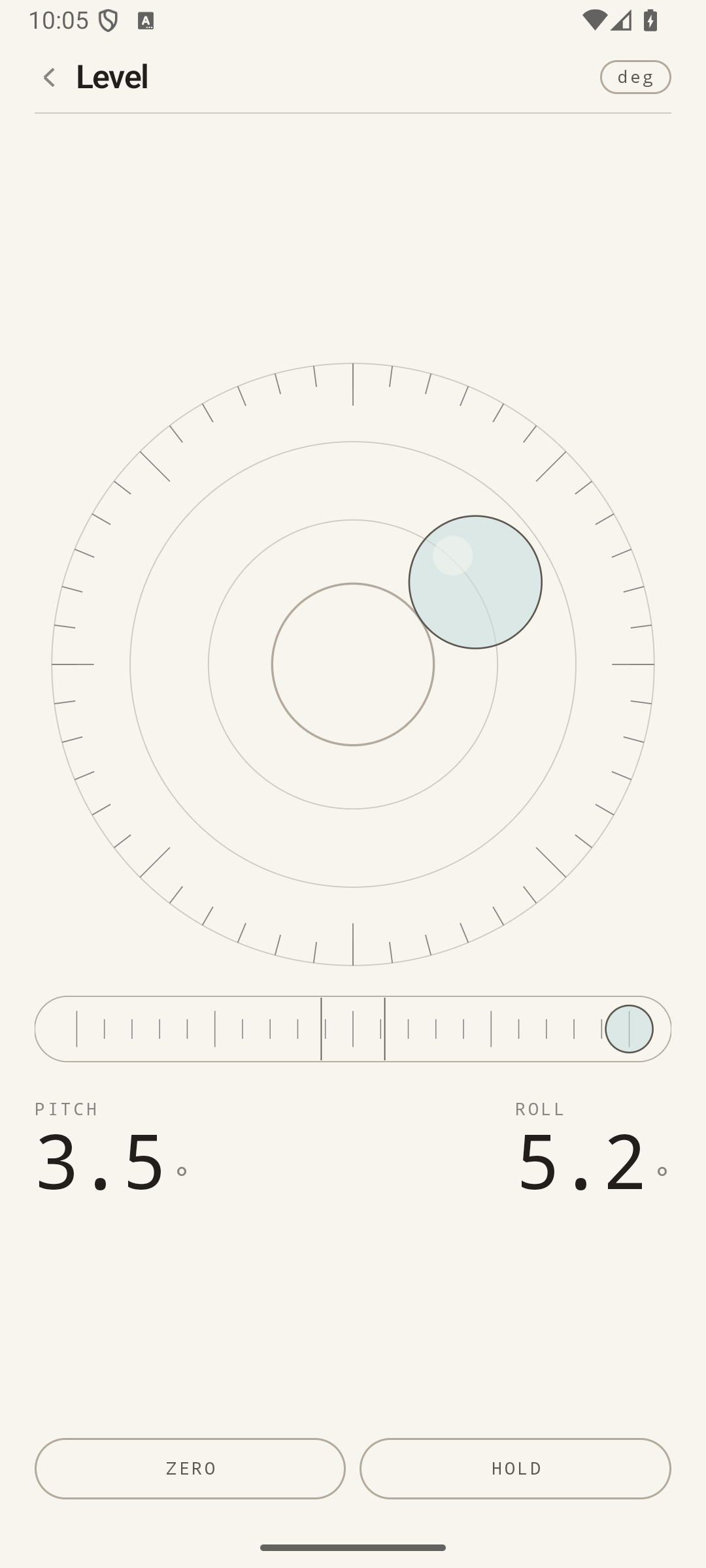
• Level, a round vial and a tube at once, with a zero point stored for your device, in degrees, percent or millimetres per metre
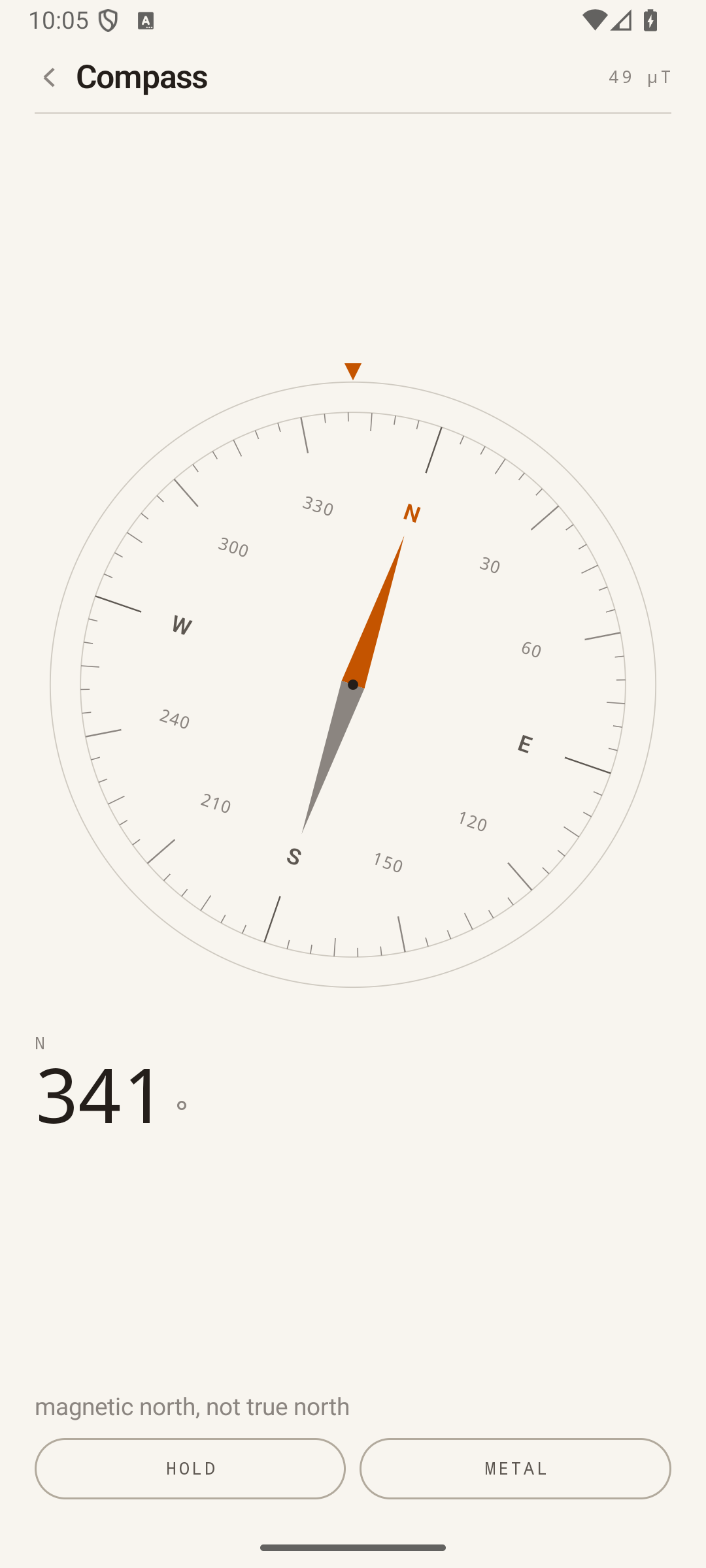
• Compass, heading and field strength, true north from a declination you set since there is no location permission to find it for you, and the same face doubles as a metal detector for finding a nail behind plaster
• Ruler, millimetres and inches, calibrated against a bank card rather than against the pixel density the panel claims
• Sound level, in dB(A) or dB(Z), with peak and minimum hold, asking the device for the unprocessed microphone so that gain control cannot rewrite the number
• Tuner, note and cents by YIN pitch detection, concert pitch adjustable from 415 to 466 Hz
• Counter, a tally you tap anywhere or raise with the volume keys, which survives closing the app
• Altimeter, height above a mark you set, exact enough to measure a staircase, with the pressure trend
• Light meter, lux across six decades, from moonlight to direct sun
• Metronome, BPM 30 to 250 and beats per bar 1 to 12 with the first beat accented, sample-accurate clicks
• G-force, the magnitude of the three accelerometer axes against standard gravity, with peak hold
Instruments your device has no sensor for are shown greyed out with the reason, instead of opening and then apologising.
What it does not do
There is no INTERNET permission in the manifest, so the app cannot send anything anywhere even by accident. The single permission is the microphone, requested when you open the sound level meter or the tuner. Nothing is recorded: each frame of audio becomes one number and is discarded. The only thing stored is the handful of calibration values for your device.
Free software, GPL-3.0-or-later.
Nonius is the other kind. Every face is drawn as an instrument rather than assembled from stock components, and every reading that depends on hardware has a calibration you can set, because no sensor is perfect and no screen reports its own size honestly.
The instruments
• Level, a round vial and a tube at once, with a zero point stored for your device, in degrees, percent or millimetres per metre
• Compass, heading and field strength, true north from a declination you set since there is no location permission to find it for you, and the same face doubles as a metal detector for finding a nail behind plaster
• Ruler, millimetres and inches, calibrated against a bank card rather than against the pixel density the panel claims
• Sound level, in dB(A) or dB(Z), with peak and minimum hold, asking the device for the unprocessed microphone so that gain control cannot rewrite the number
• Tuner, note and cents by YIN pitch detection, concert pitch adjustable from 415 to 466 Hz
• Counter, a tally you tap anywhere or raise with the volume keys, which survives closing the app
• Altimeter, height above a mark you set, exact enough to measure a staircase, with the pressure trend
• Light meter, lux across six decades, from moonlight to direct sun
• Metronome, BPM 30 to 250 and beats per bar 1 to 12 with the first beat accented, sample-accurate clicks
• G-force, the magnitude of the three accelerometer axes against standard gravity, with peak hold
Instruments your device has no sensor for are shown greyed out with the reason, instead of opening and then apologising.
What it does not do
There is no INTERNET permission in the manifest, so the app cannot send anything anywhere even by accident. The single permission is the microphone, requested when you open the sound level meter or the tuner. Nothing is recorded: each frame of audio becomes one number and is discarded. The only thing stored is the handful of calibration values for your device.
Free software, GPL-3.0-or-later.