ProcrastiLearn
Block distracting apps until you review a spaced-repetition flashcard
Version: 1.4.6
Added: 24-06-2026
Updated: 14-10-2026
Added: 24-06-2026
Updated: 14-10-2026
There's Anki on your phone, there's Duolingo, and you do mean to get around to them. Then you pick the phone up, and twenty minutes later you're somewhere in TikTok, not really sure how you got there.
ProcrastiLearn steps in right at that moment. It catches you just as you're about to disappear into another time sink, and asks you for one word first.
That's how mindless app-opening turns into vocabulary practice. Choose which apps you tend to open out of habit — social media, browsers, games — and whenever you launch one, a full-screen flashcard overlay appears. Reveal the translation, rate how well you remembered it, and the app you wanted opens immediately. No subscription, no ads, no accounts.
HOW IT WORKS
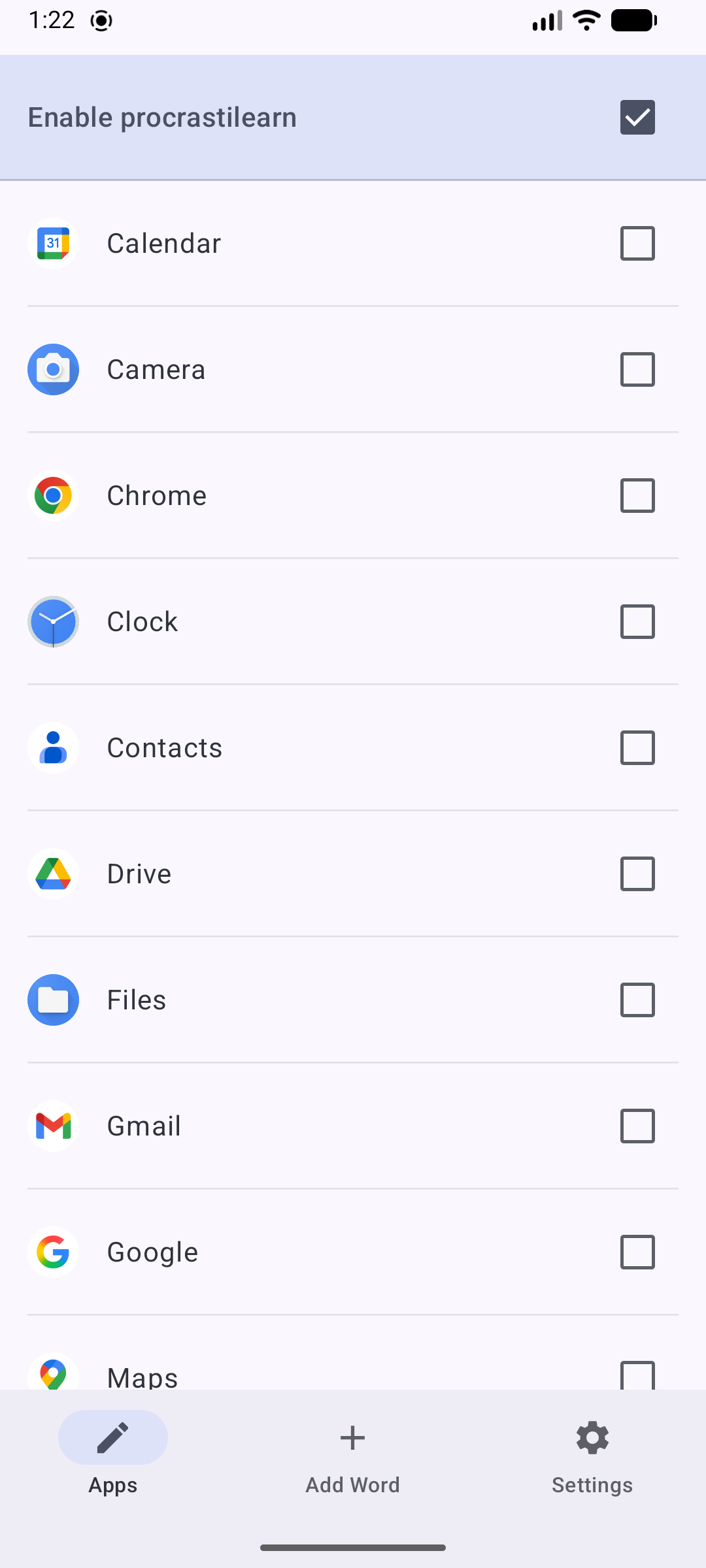
Pick the apps you want to gate in the Apps tab. From that point on, opening any of those apps shows a flashcard first. You rate your answer (Again / Hard / Good / Easy) and the FSRS spaced-repetition algorithm schedules the next review automatically. Daily caps prevent you from being overwhelmed.
If you tend to lose track of time once you're inside a gated app, the optional recurring reminder has you covered: set an interval (e.g. every 3 minutes) and the overlay reappears as long as you stay in that app, turning each lingering session into extra review reps.
VOCABULARY
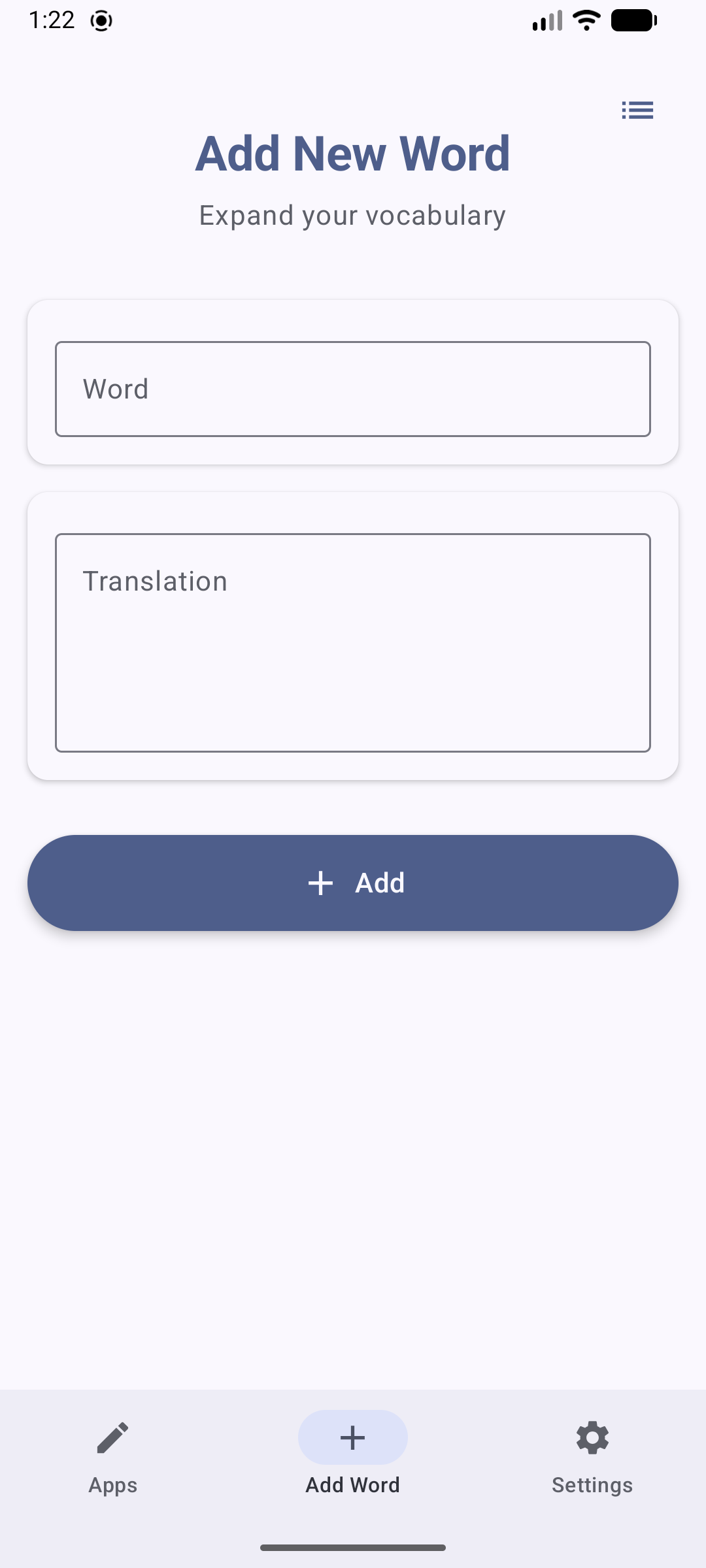
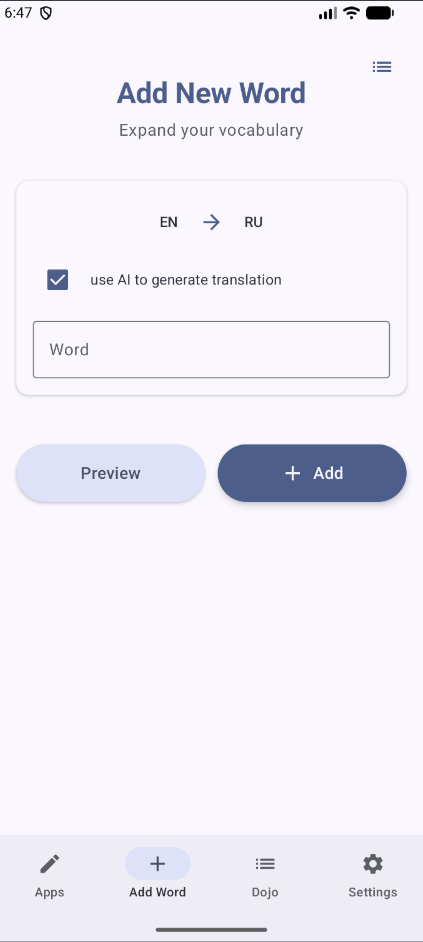
Add words manually or use the optional AI translation feature: paste a word, tap Generate, and the app drafts a translation using OpenAI. The AI prompt is fully editable so you can control tone, context, or target language.
You can also import existing Anki decks (.apkg files) to get started immediately with a vocabulary set you already trust. After that you can be sure that you'll learn it eventually, while watching tiktok or your favourite YouTuber.
Come across a word somewhere else — an article, a chat, another app? Select it and tap "ProcrastiLearn this" from the menu to add it right away, no need to switch apps first.
LANGUAGE SUPPORT
The AI prompt automatically adapts to whatever native and target languages you choose in Settings: explanations appear in your native language, and examples in the language you're learning. Any language pair works out of the box — no manual prompt editing needed. Further language-related improvements will keep arriving, especially based on user requests in GitHub issues or via email.
PRIVACY
All data — vocabulary, blocked apps list, review history, and settings — is stored entirely on your device. There are no analytics, no crash reporters, and no advertising SDKs. The only outbound network traffic is the optional OpenAI API call you initiate by tapping Generate, using your own API key entered in Settings.
PERMISSIONS
Accessibility Service: used solely to detect which app is currently in the foreground so ProcrastiLearn knows when to show the overlay. The service does not read screen content, keystrokes, or any other input.
Display Over Other Apps: required to draw the flashcard overlay on top of the gated app.
OPEN SOURCE
ProcrastiLearn is free and open-source software (Apache 2.0 license). Source code and issue tracker are on GitHub.
ProcrastiLearn steps in right at that moment. It catches you just as you're about to disappear into another time sink, and asks you for one word first.
That's how mindless app-opening turns into vocabulary practice. Choose which apps you tend to open out of habit — social media, browsers, games — and whenever you launch one, a full-screen flashcard overlay appears. Reveal the translation, rate how well you remembered it, and the app you wanted opens immediately. No subscription, no ads, no accounts.
HOW IT WORKS
Pick the apps you want to gate in the Apps tab. From that point on, opening any of those apps shows a flashcard first. You rate your answer (Again / Hard / Good / Easy) and the FSRS spaced-repetition algorithm schedules the next review automatically. Daily caps prevent you from being overwhelmed.
If you tend to lose track of time once you're inside a gated app, the optional recurring reminder has you covered: set an interval (e.g. every 3 minutes) and the overlay reappears as long as you stay in that app, turning each lingering session into extra review reps.
VOCABULARY
Add words manually or use the optional AI translation feature: paste a word, tap Generate, and the app drafts a translation using OpenAI. The AI prompt is fully editable so you can control tone, context, or target language.
You can also import existing Anki decks (.apkg files) to get started immediately with a vocabulary set you already trust. After that you can be sure that you'll learn it eventually, while watching tiktok or your favourite YouTuber.
Come across a word somewhere else — an article, a chat, another app? Select it and tap "ProcrastiLearn this" from the menu to add it right away, no need to switch apps first.
LANGUAGE SUPPORT
The AI prompt automatically adapts to whatever native and target languages you choose in Settings: explanations appear in your native language, and examples in the language you're learning. Any language pair works out of the box — no manual prompt editing needed. Further language-related improvements will keep arriving, especially based on user requests in GitHub issues or via email.
PRIVACY
All data — vocabulary, blocked apps list, review history, and settings — is stored entirely on your device. There are no analytics, no crash reporters, and no advertising SDKs. The only outbound network traffic is the optional OpenAI API call you initiate by tapping Generate, using your own API key entered in Settings.
PERMISSIONS
Accessibility Service: used solely to detect which app is currently in the foreground so ProcrastiLearn knows when to show the overlay. The service does not read screen content, keystrokes, or any other input.
Display Over Other Apps: required to draw the flashcard overlay on top of the gated app.
OPEN SOURCE
ProcrastiLearn is free and open-source software (Apache 2.0 license). Source code and issue tracker are on GitHub.