ResticDroid
Scheduled, encrypted backups with restic
Version: 0.3.0
Added: 12-10-2026
Updated: 12-10-2026
Added: 12-10-2026
Updated: 12-10-2026
ResticDroid backs your phone up with restic, the open-source backup program, to
storage you control: Backblaze B2, S3-compatible object storage, a REST server,
or a folder on an SD card. Everything is encrypted and deduplicated on
the device before it is sent, so the storage provider only ever holds
ciphertext.
The restic binary is compiled from source as part of the F-Droid build and runs
as a child process. The snapshots it writes are ordinary restic snapshots: you
can open them with restic on a desktop, and nothing about them depends on this
app. If ResticDroid disappears tomorrow, your backups do not become unreadable.
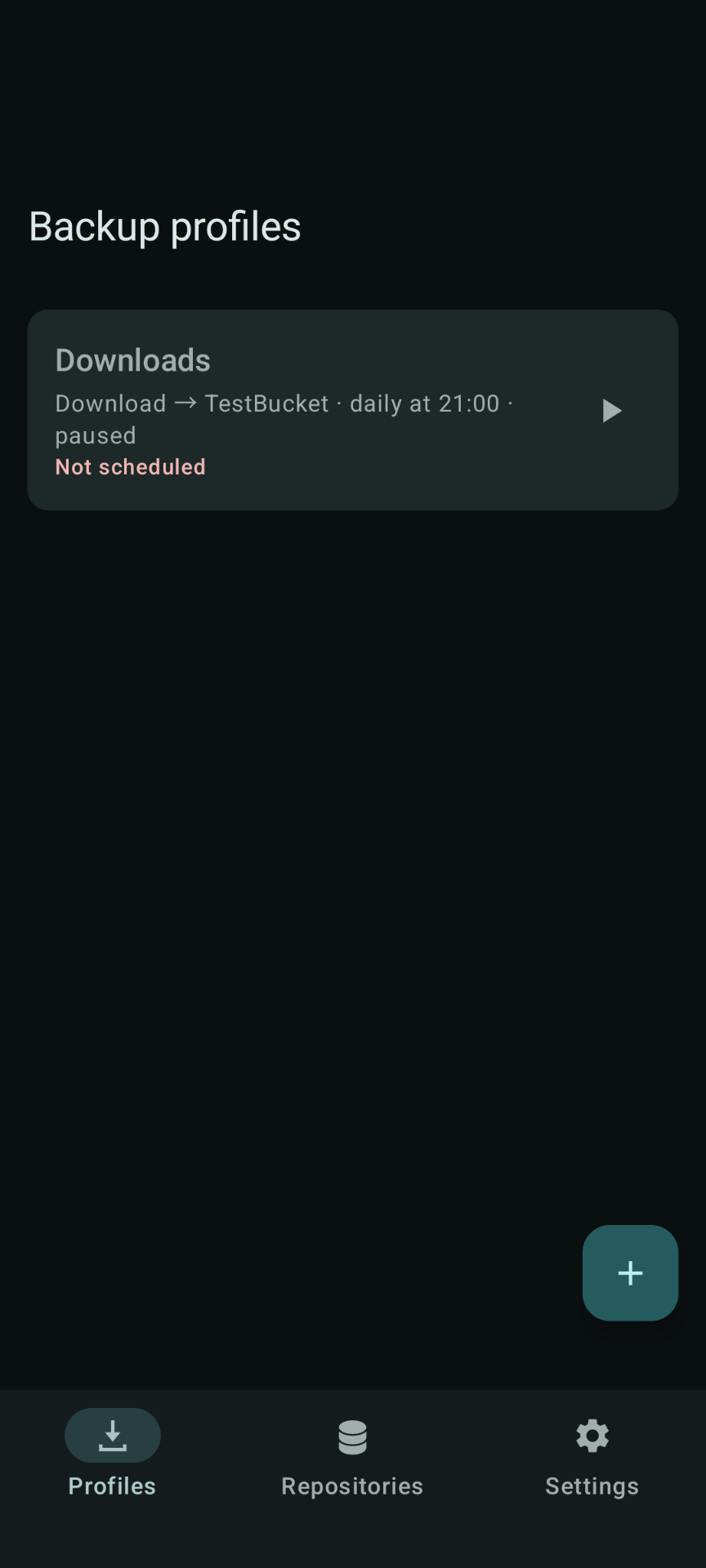
Backup profiles
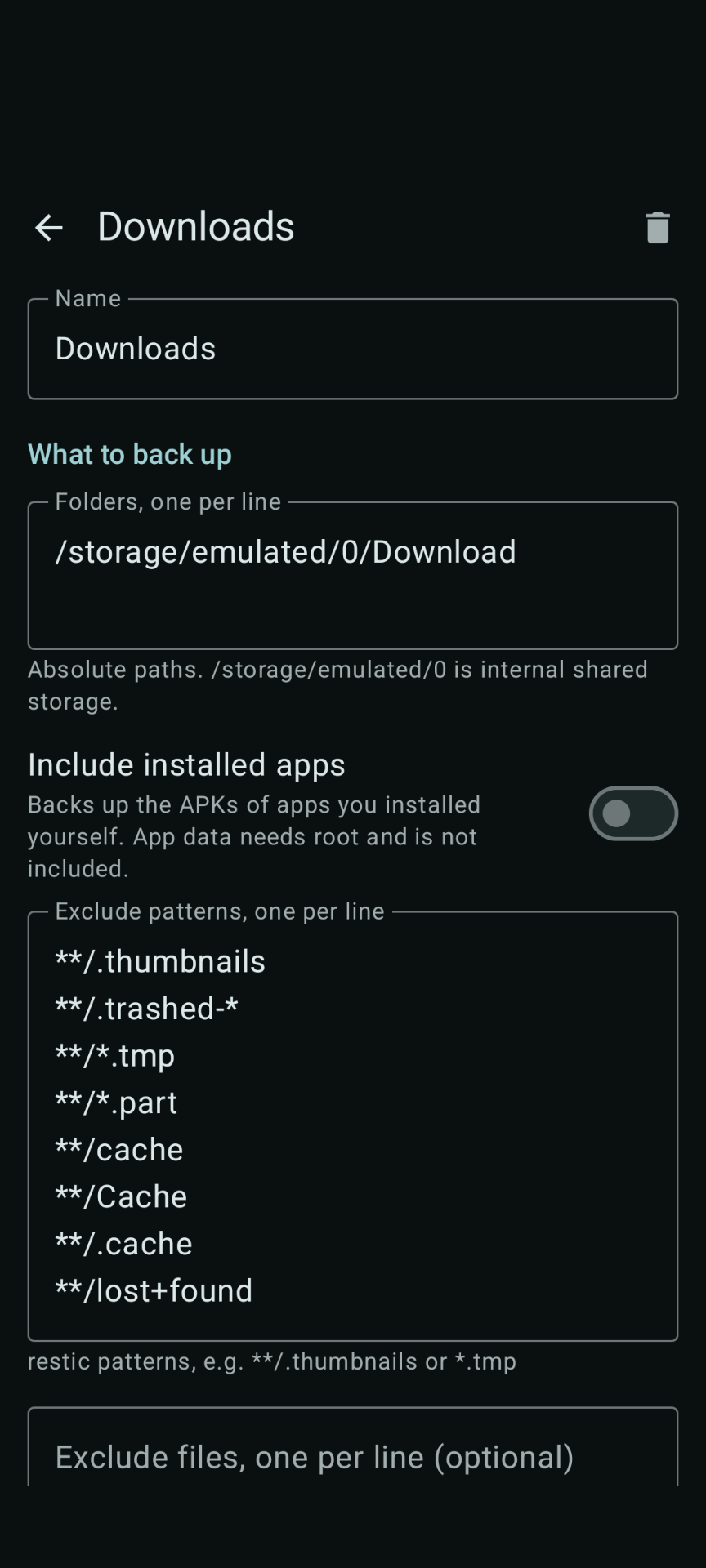
A profile says what to back up, where to send it, and when. Start from one of
the ready-made sets — photos and media, documents and downloads, installed apps,
or all of shared storage — and adjust it.
Conditions for scheduled runs
Only while charging. Only on an unmetered network. Only on Wi-Fi networks you
name. Only above a battery level you choose. These become system constraints, so
the phone is not woken up to discover it cannot run.
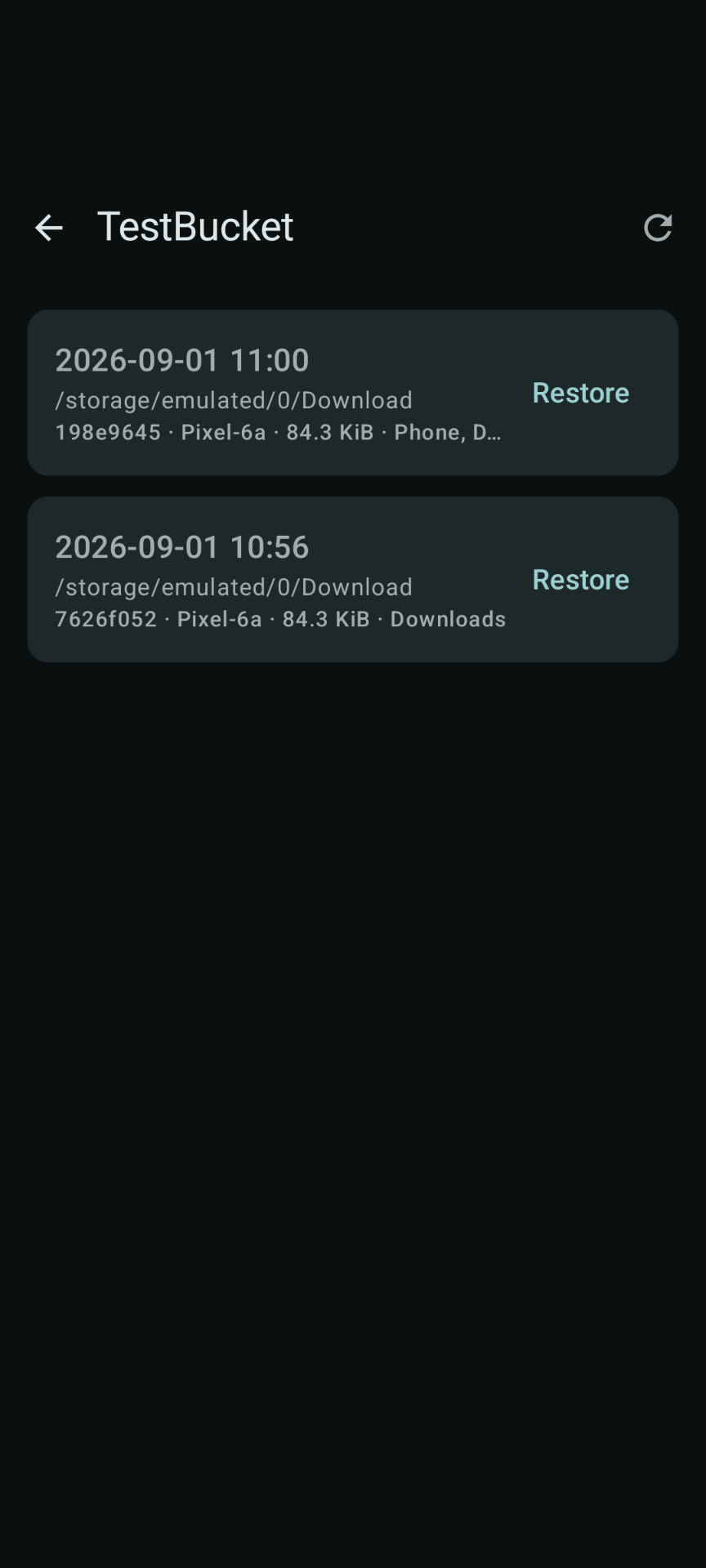
Repositories
Backblaze B2, S3 and S3-compatible services, Azure Blob Storage, Google Cloud
Storage, OpenStack Swift, a restic REST server, or a local folder. Create a new
repository from the app, or point it at one that already exists.
SFTP and rclone are not offered: restic implements those by running the "ssh"
and "rclone" programs, which Android does not have. Use a REST server or an
S3-compatible gateway instead.
Security
Repository passwords and API keys live in the Android keystore, hardware-backed
on devices that have a secure element, and never appear in the configuration
files. Backups and restores that you start yourself can be gated behind your
fingerprint, or the repository password. Scheduled runs are not prompted, because a backup
that waits for a fingerprint at 3am is a backup that does not happen.
Configuration you can read
Everything you configure is plain text under /storage/emulated/0/ResticDroid -
one file per profile, one per repository. Edit it in any text editor, over USB
or on the phone, and the app picks the change up immediately. There is no
database, and nothing to import or export.
No recursive backups
A repository stored on the device is excluded from every backup automatically,
whether or not it is the one being written to. You do not have to remember to
write that rule yourself.
What it does not do
App data cannot be backed up without root, and ResticDroid does not use root or
pretend otherwise. It backs up the APKs of apps you installed, so a new phone
can be rebuilt, but their data stays where it is.
Privacy
No analytics, no crash reporting, no advertising identifiers, no Google Play
services. The app connects to nothing except the repositories you configure.
storage you control: Backblaze B2, S3-compatible object storage, a REST server,
or a folder on an SD card. Everything is encrypted and deduplicated on
the device before it is sent, so the storage provider only ever holds
ciphertext.
The restic binary is compiled from source as part of the F-Droid build and runs
as a child process. The snapshots it writes are ordinary restic snapshots: you
can open them with restic on a desktop, and nothing about them depends on this
app. If ResticDroid disappears tomorrow, your backups do not become unreadable.
Backup profiles
A profile says what to back up, where to send it, and when. Start from one of
the ready-made sets — photos and media, documents and downloads, installed apps,
or all of shared storage — and adjust it.
Conditions for scheduled runs
Only while charging. Only on an unmetered network. Only on Wi-Fi networks you
name. Only above a battery level you choose. These become system constraints, so
the phone is not woken up to discover it cannot run.
Repositories
Backblaze B2, S3 and S3-compatible services, Azure Blob Storage, Google Cloud
Storage, OpenStack Swift, a restic REST server, or a local folder. Create a new
repository from the app, or point it at one that already exists.
SFTP and rclone are not offered: restic implements those by running the "ssh"
and "rclone" programs, which Android does not have. Use a REST server or an
S3-compatible gateway instead.
Security
Repository passwords and API keys live in the Android keystore, hardware-backed
on devices that have a secure element, and never appear in the configuration
files. Backups and restores that you start yourself can be gated behind your
fingerprint, or the repository password. Scheduled runs are not prompted, because a backup
that waits for a fingerprint at 3am is a backup that does not happen.
Configuration you can read
Everything you configure is plain text under /storage/emulated/0/ResticDroid -
one file per profile, one per repository. Edit it in any text editor, over USB
or on the phone, and the app picks the change up immediately. There is no
database, and nothing to import or export.
No recursive backups
A repository stored on the device is excluded from every backup automatically,
whether or not it is the one being written to. You do not have to remember to
write that rule yourself.
What it does not do
App data cannot be backed up without root, and ResticDroid does not use root or
pretend otherwise. It backs up the APKs of apps you installed, so a new phone
can be rebuilt, but their data stays where it is.
Privacy
No analytics, no crash reporting, no advertising identifiers, no Google Play
services. The app connects to nothing except the repositories you configure.