Rune
Private, on-device encrypted notes. No network, no telemetry, no trackers.
Version: 0.5.7
Added: 14-10-2026
Updated: 14-10-2026
Added: 14-10-2026
Updated: 14-10-2026
Rune is a calm, fast notes app for people who don't want to trust an app with
their data. Your notes never leave your device, they are encrypted at rest, and
the app makes no network connections at all. There is no account, no cloud, and
no sign-up.
Privacy by construction, not by promise:
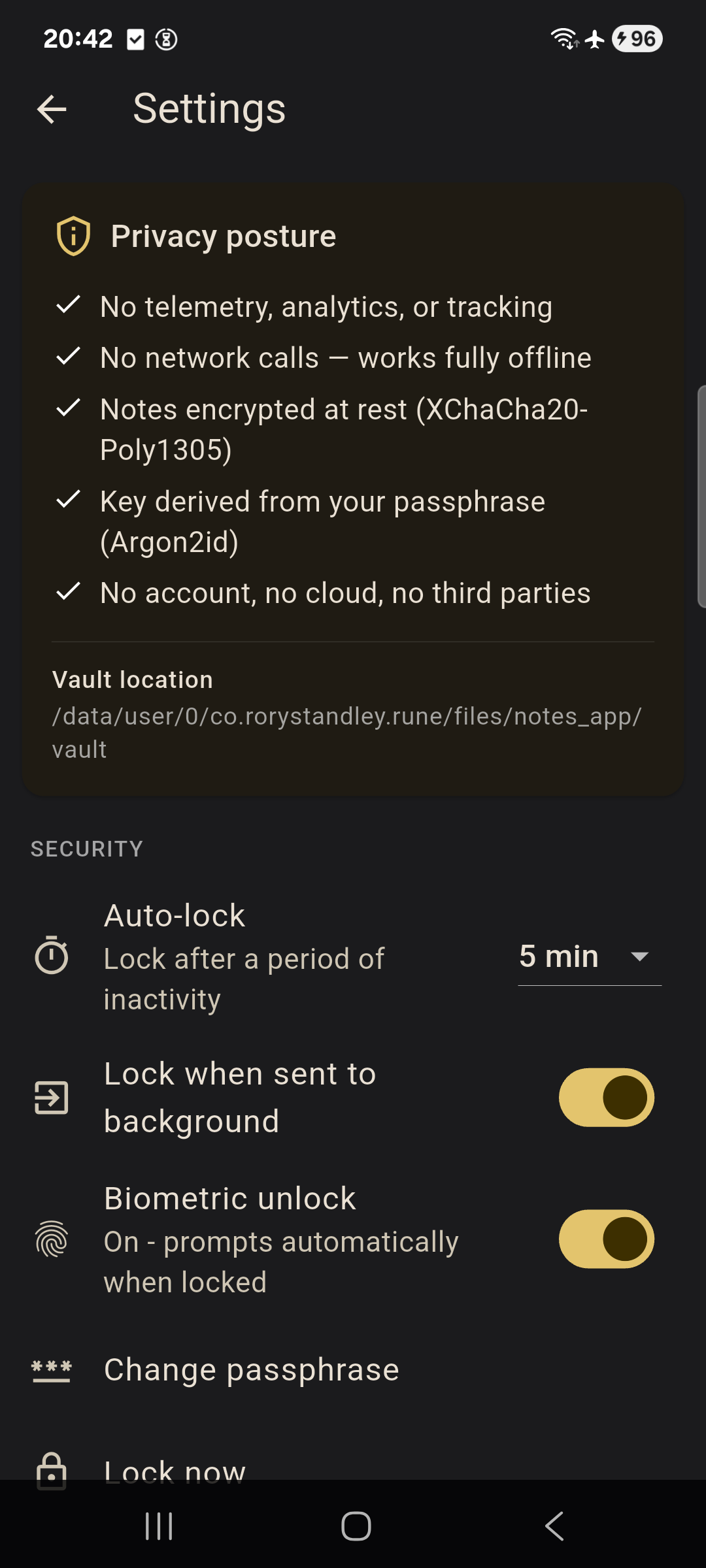
* No telemetry, no analytics, no crash reporting, no advertising, no tracking —
none, not "anonymised", not "aggregated".
* No networking code. Put your device in airplane mode and everything still
works. If anything ever tries to reach the network, that is a bug.
* No account and no server. There is no "we" that could hold your data.
Real encryption:
* Your passphrase derives a key with Argon2id; notes are sealed with
XChaCha20-Poly1305 authenticated encryption. Only ciphertext is ever written
to disk.
* The passphrase is never stored and is not recoverable. If you forget it, your
notes are gone — no reset, no backdoor. That is the price of real privacy.
* A wrong passphrase simply cannot decrypt your notes.
What you can do:
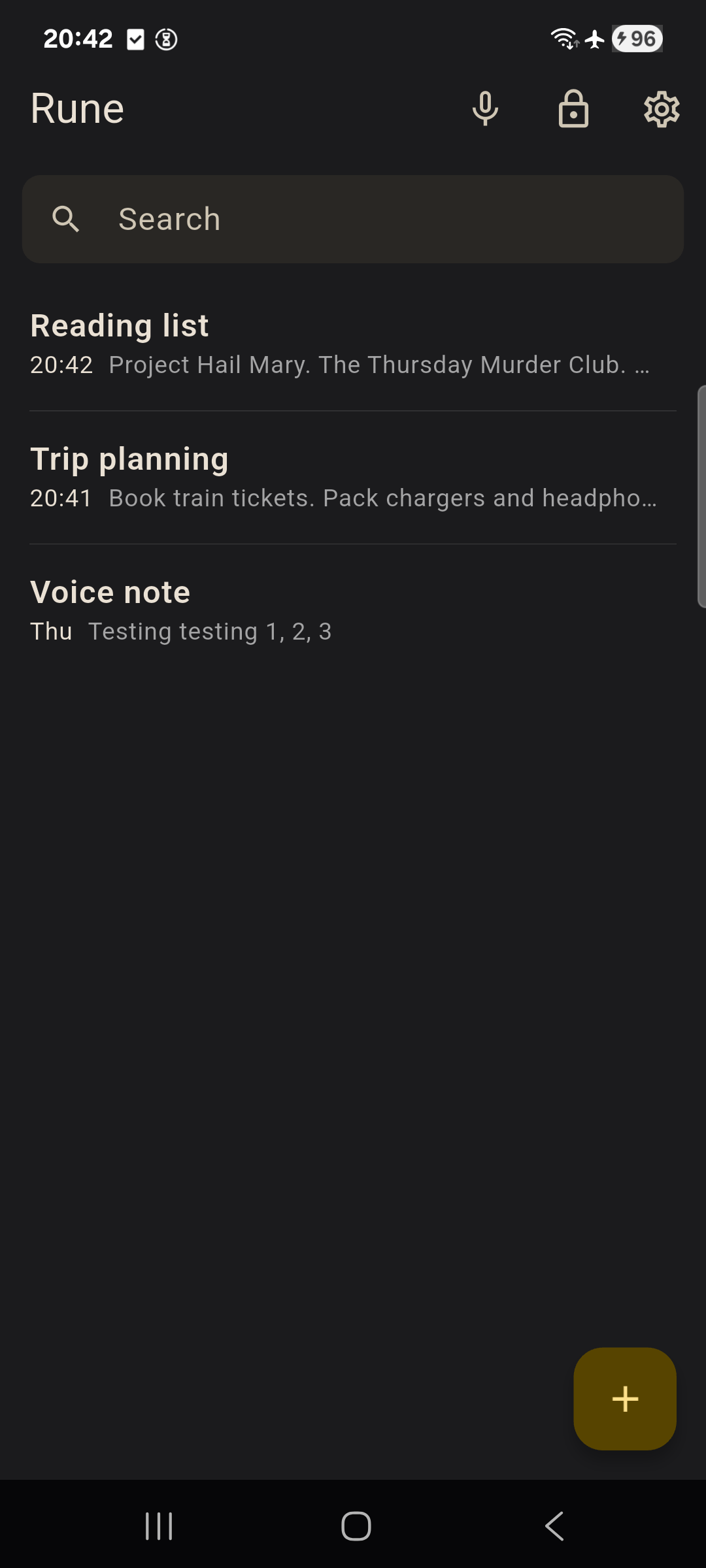
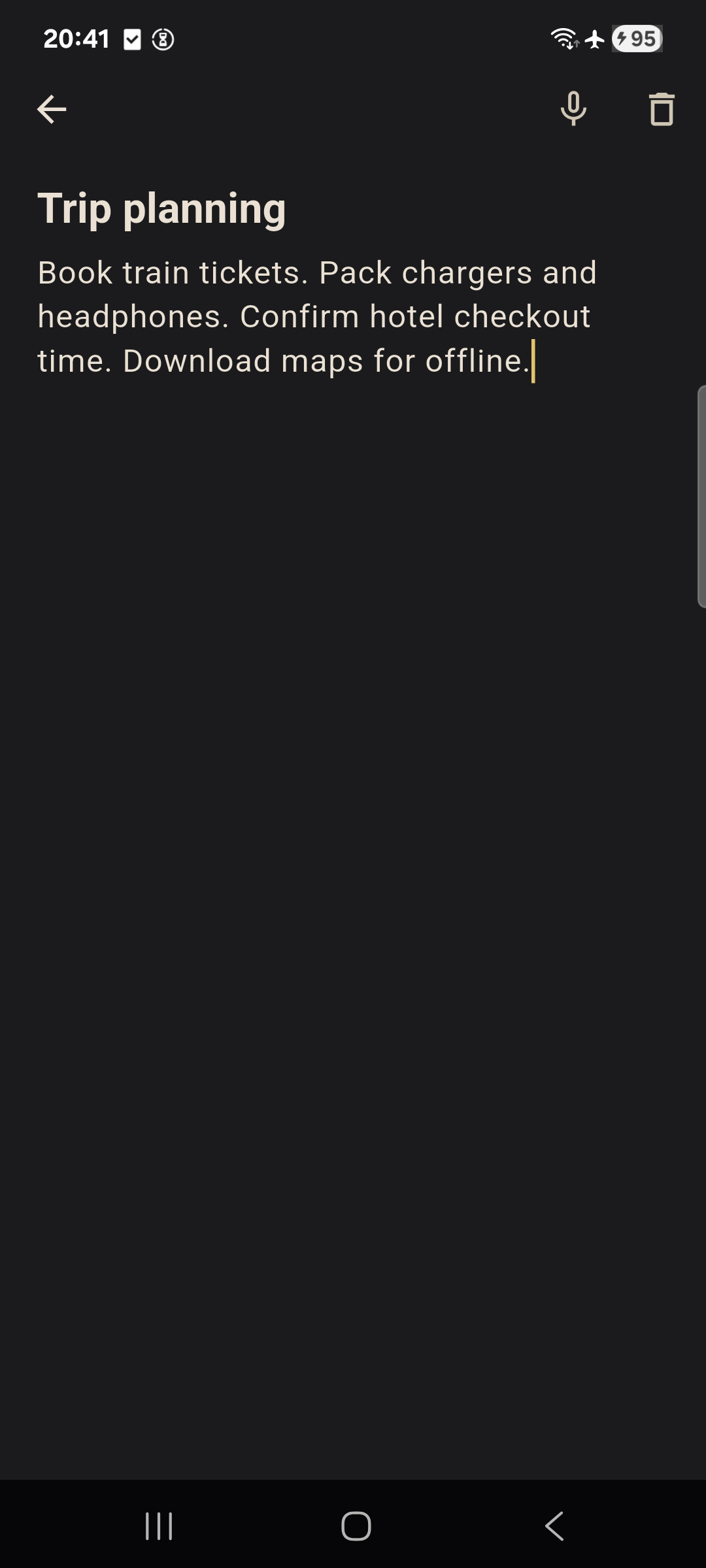
* Create, edit, search, and organise plain-text notes with an Apple-Notes-style
layout that adapts from phone to desktop.
* Auto-lock on inactivity and lock-on-background; the app starts locked.
* Export an encrypted backup (safe to keep anywhere); plaintext export is gated
behind an explicit warning.
* Capture voice notes — recording stays entirely on your device.
Free and open source under the GNU GPL, version 3 or later. The security-critical code is a small,
dependency-light, pure-Dart core so it can be read and audited. Releases published on
GitHub ship with cryptographic provenance (SLSA build-provenance attestations
and a keyless cosign signature) so you can verify those binaries were built from
this source. Builds distributed by F-Droid are built and signed by F-Droid
itself and are not covered by that provenance.
This is honest software: it tells you what it does not yet do. See the project's
SECURITY.md for the threat model and current limitations.
their data. Your notes never leave your device, they are encrypted at rest, and
the app makes no network connections at all. There is no account, no cloud, and
no sign-up.
Privacy by construction, not by promise:
* No telemetry, no analytics, no crash reporting, no advertising, no tracking —
none, not "anonymised", not "aggregated".
* No networking code. Put your device in airplane mode and everything still
works. If anything ever tries to reach the network, that is a bug.
* No account and no server. There is no "we" that could hold your data.
Real encryption:
* Your passphrase derives a key with Argon2id; notes are sealed with
XChaCha20-Poly1305 authenticated encryption. Only ciphertext is ever written
to disk.
* The passphrase is never stored and is not recoverable. If you forget it, your
notes are gone — no reset, no backdoor. That is the price of real privacy.
* A wrong passphrase simply cannot decrypt your notes.
What you can do:
* Create, edit, search, and organise plain-text notes with an Apple-Notes-style
layout that adapts from phone to desktop.
* Auto-lock on inactivity and lock-on-background; the app starts locked.
* Export an encrypted backup (safe to keep anywhere); plaintext export is gated
behind an explicit warning.
* Capture voice notes — recording stays entirely on your device.
Free and open source under the GNU GPL, version 3 or later. The security-critical code is a small,
dependency-light, pure-Dart core so it can be read and audited. Releases published on
GitHub ship with cryptographic provenance (SLSA build-provenance attestations
and a keyless cosign signature) so you can verify those binaries were built from
this source. Builds distributed by F-Droid are built and signed by F-Droid
itself and are not covered by that provenance.
This is honest software: it tells you what it does not yet do. See the project's
SECURITY.md for the threat model and current limitations.